
by Kathy Stahr | Jun 19, 2020 | Member News
U.S., CANADIAN NGB/NSOs FORM NORTH AMERICAN FLUOROCARBON FREE POLICY WORKING GROUP
PARK CITY, Utah (June 15, 2020) – National Governing Body’s and National Sport Organizations (NGB/NSOs), and snow sport organizations from the United States and Canada today are announcing the formation of a Fluorocarbon Free Policy Working Group.
With representation from U.S. Ski & Snowboard, USA Nordic, U.S. Biathlon, U.S. Paralympics Nordic Skiing, U.S. Paralympics Alpine Skiing, Alpine Canada, Canada Snowboard, Freestyle Canada, Nordiq Canada, Biathlon Canada, Nordic Combined Canada and Ski Jumping Canada in addition to industry wax representatives, the working group is tasked with setting policy to eliminate the use of fluorinated ski wax from all sanctioned levels of snow sports competition in North America beginning with the 2020-21 season.
In 2019, the International Ski Federation (FIS) and International Biathlon Union (IBU) decided that the use of fluorinated ski wax will be banned for all FIS and IBU disciplines beginning with the upcoming 2020-21 season. In addition, U.S. Ski & Snowboard voted to eliminate the use of fluorinated ski wax from all levels of competition at it’s May 2020 meeting. The Canadian Ski Association (CSA) has adopted the FIS Council Ruling and is extending it to all programs that fall under its authority.
Fluorinated wax, and the raw perfluorooctanoic acid (PFOA) compounds that make up these wax products, have been scientifically studied for their negative environmental and health impacts. In the United States, many of the compounds found in fluorinated wax products contain ingredients listed in the Toxic Substances Control Act. In July 2020 the European Chemicals Agency will ban the sale, manufacture, and import of all products containing PFOAs.
The Fluorocarbon Free Policy Working Group began meeting on a regular basis to facilitate the many facets of developing policy and rules that will harmonize all levels of domestic competition and training with FIS and IBU rules and regulations, and will lead to a complete ban of fluorinated wax products at all levels of sanctioned competition. The Working Group is committed to:
- Asking manufacturers to work toward providing a list of waxes where the manufacturer represents that the wax is free of fluorinated products
- Working with FIS and the IBU to coordinate the testing process and thresholds below the World Championships/World Cup level
- Establishing rules, deterrents, and appeals process
- Establishing clear and concise stakeholder communications
While key questions remain, including testing, enforcement, and ultimately sanctions for using fluorinated products, all participating NGBs in the United States and NSOs in Canada are fully committed to banning the use of fluorinated wax from all levels of sanctioned snow sports competition starting with the 2020-21 ski and snowboard season.

by Keven Dubinsky | Jun 10, 2020 | Member News
Province takes action to support return to sport
British Columbians will be able to get back to playing sports sooner with the Province’s action to protect amateur sport organizations from COVID-19 liabilities, provided they are complying with public health orders and provincial sport guidelines.
Government has created a ministerial order that protects amateur sport organizations, their employees and volunteers from liability.
“We want to make sure children and their families can get the benefits of physical activity and get back to playing the sports they love,” said Lisa Beare, Minister of Tourism, Arts and Culture. “Many sports organizations are run by volunteers who need to make sure they are protected for risks related to COVID-19. This order will help cover that risk so people can safely get back to playing sports sooner in their communities.”
Provincial and local sport organizations have identified challenges with obtaining adequate insurance as a result of the pandemic. Most insurance companies are not providing coverage for COVID-19 related damages, meaning many amateur sports were unable to provide sport programming during the pandemic.
The ministerial order protects amateur sport organizations and their representatives from damages resulting, directly or indirectly, from COVID-19 for amateur sports. For example, a sports organization or its representatives will not be liable for a participant in their sports program being exposed to COVID-19 as a result of participation. That liability protection would be in place as long as they follow applicable guidance, such as viaSport’s Return to Sport protocols and public-health guidance on how to prevent the spread of the virus. This guidance includes encouraging proper handwashing, regular disinfecting, limiting shared equipment, physical distancing measures and the use of wellness questionnaires and health self-assessment tools.
"We are thrilled that sport is making its return in the province. Today's announcement is welcome news for our partners in the amateur sport sector,” said Charlene Krepiakevich, CEO of viaSport. “This co-ordinated response to address concerns around volunteer and staff liability means that these not-for-profit organizations can focus on delivering safe, high-quality sport experiences for the people in their communities."
Quick Facts:
- There are 72 funded provincial sport organizations and 4,100 local sport organizations with over 800,000 youth and adult participants throughout B.C.
- ViaSport British Columbia is a not-for-profit organization created with the support of the provincial government in 2011 to lead the province’s sport sector to build a stronger, more effective system that brings more families to the field of play, more fans into the stands, more athletes to the podium and more sports events to the province.
Learn More:
To view the ministerial order, visit: http://www.bclaws.ca/civix/content/mo/mo/1115649140/?xsl=/templates/browse.xsl
For non-health related information, including financial, child care and education supports, travel, transportation and essential service information, visit: www.gov.bc.ca/Covid-19
Or call 1 888 COVID19 (1 888 268-4319) between 7:30 a.m. and 8 p.m. (Pacific time), seven days a week.
To view the list of the provincial health officer’s orders, visit: www.gov.bc.ca/phoguidance
To learn more about viaSport and the Return to Sport Guidelines, visit: https://www.viasport.ca/sites/default/files/ReturntoSportGuidelines.pdf
Read the official BC Government Release
by Kathy Stahr | Jun 4, 2020 | Member News
As a Provincial Sport Organization and member of Alpine Canada, BC Alpine fully supports and embraces the following message https://alpinecanada.org/news/a-message-from-alpine-canada1
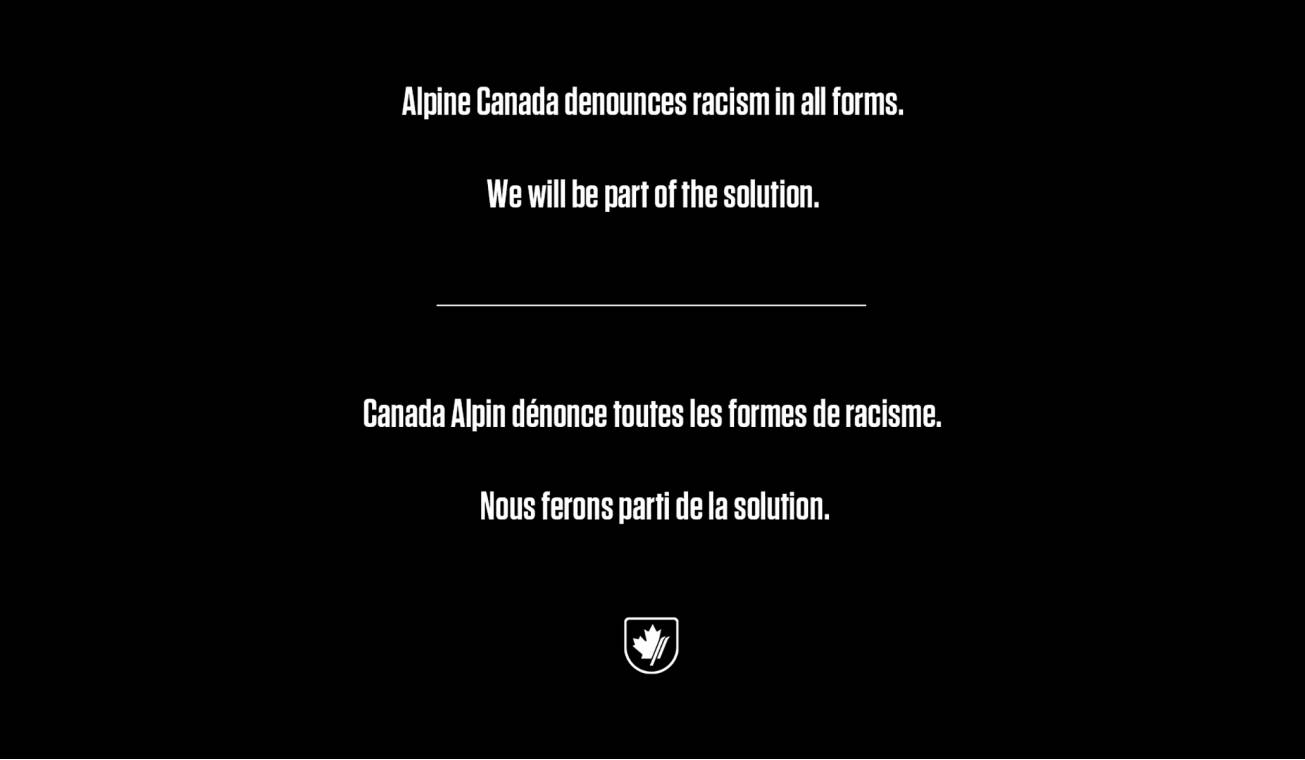
Protests around the world have focused attention on racial injustice for people of colour. Alpine Canada stands with all of those who are working to achieve a racially just society and against all those who perpetuate and uphold racism, hatred, bigotry, and violence.
Alpine Canada condemns racism and discrimination in all forms. We are committed to creating an environment where all are valued and included, on the slopes and off.
We are committed to making ski racing a more diverse, inclusive, and accessible sport. We will listen, educate ourselves and work toward cultural change in the sport we love and to be more mindful of the work we must do to address our shortcomings in this process.
by Kathy Stahr | Jun 2, 2020 | Member News
|
Here are the Return to Sport Guidelines published by viaSport.
The next step for BC Alpine is to create our own sport-specific set of guidelines that align with those from viaSport and have them approved by our Board of Directors. Our team is hard at work preparing that document right now, and our #1 priority is to share it with our clubs as soon as possible!
MPORTANT NOTE: Once the BC Alpine guidelines are made available on our website, all clubs will be required to create their own board-approved guidelines before they can safely and confidently return to club activities!
Stay tuned 🙂
|
by Kathy Stahr | May 19, 2020 | Member News
READ VIASPORT NEWS

Together we can make a great comeback
Sport is returning to British Columbia. It will resume in accordance with the phases outlined in B.C.’s Restart Plan. At the request of the Province of B.C., viaSport is leading the creation of a set of guidelines on how to resume sport while operating safely during this pandemic – the Return to Sport Guidelines. These guidelines will be issued following review and approval by a cross-ministry oversight committee supported by guidance and advice of provincial health officials and WorkSafe BC.
Return to sport process for amateur sport
As outlined in B.C.’s Restart Plan, during Phase Two sport activities organized and operated by Provincial Sport Organizations (PSOs) and Disability Sport Organizations (DSOs) can resume in a limited way.
- Once the sector Return to Sport Guidelines are released, PSOs and DSOs will develop sport-specific return to sport guidelines. These sport-specific guidelines need to be approved by their respective Boards of Directors before any activities can resume.
- In order to assess all of the possible risks, PSOs and DSOs should understand their current insurance policy in relation to contagion coverage.
- Local Sport Organizations (LSOs), affiliated with a PSO or DSO, will adapt and/or adopt the approved PSO guidelines when creating their own guidelines, and it is recommended to have these approved by their own boards before resuming activities.
- In order to assess all of the possible risks, LSOs should understand their current insurance policy in relation to contagion coverage.
For the foreseeable future, sport will be more geared towards community participation and training rather than games and provincial competition. Further information will be shared once it becomes available.
Minister’s message regarding return to play
FAQs
Return to Sport Guidelines for B.C. (coming soon)
BC’s Restart plan
Recreation, leisure and individual training activities
With the reopening of parks and both municipal and private recreation facilities in our communities, casual or leisure activities have also begun to resume. These activities should not be organized or operated by a PSO, LSO or DSO. Participation in these activities is at the discretion of the individual and should adhere to current public health recommendations. Individuals are encouraged to go outdoors for personal exercise and to remain active in their communities during this time. Casual or leisure activities include but are not limited to: skill development, leisure sport and individual training. Please consult your local or municipal authorities, or the facility itself, for their specific COVID-19 guidelines to help you decide if you will partake in these activities.
Individuals
We know individuals are eager to resume physical activity and parents are eager to see their children active and participating in sport and recreation again. At this time, the safety of our children, our fellow citizens and communities is of the utmost importance. Adhere to public health recommendations when you begin to reintroduce this into your lives as recreation, leisure and individual training activities only at this time. As a reminder these activities should not be organized or operated by a PSO, LSO or DSO.
* note regarding BC Alpine's Return to Sport Plan: It will be published after (a) we receive guidelines from the government, (b) we have had time to create a plan based on those guidelines and (c) we have received approval from our Board of Directors.
by Kathy Stahr | May 18, 2020 | Member News
 Last October, I competed in my very first World Cup in Solden, Austria. It was a goal I had set for myself after the previous season—I was well ranked and ready for my first crack at a World Cup. It was something I had dreamed of since the beginning of my ski racing career, but when I finally crossed that finish line I was left feeling disappointed. I was focused on everything I had done wrong and everything that I needed to do better. It felt like I had so far to go in order to succeed on this circuit, and I had completely forgotten about the achievement of my long-time goal.
My 2019/2020 season started a little differently—I was back at school. After finishing the 2018/2019 season with some career-best results, my decision to attend Montana State University came as a shock to many. Upon reflection, I believe that that decision was a key part of my success. Believe it or not, schoolwork was my stress reliever. Although it can be stressful in and of itself, it was an alternate focus from the usual skiing focus. School was a mental break, even though I was still using my brain. And it kept me from logging too many hours on Netflix.
Starting school in late August, I had the difficult task of convincing my new professors that a 22-year-old freshman from Canada who is about to miss 9 weeks of the semester is not going to flunk their class. After only two weeks of classes, I arrived in Europe and was ready to start the fall training block. I had only one goal for the end of our European glacier training: Solden. During the two training camps, my days were busy: wake up, eat breakfast, wait in the morning lift line (for far too long), train on the glacier, download, eat lunch, do homework, do dryland, more homework, eat dinner, and early to bed. Only to do it all over again the next day.
By the time we were nearing the end of our second camp in Hintertux, Austria, and fast approaching the World Cup opener, I was informed that I and a few other team members would drive to Solden to compete in a time trial for the final starting spot. Additionally, each of the ski companies had prepared glide tracks in Solden for athletes to obtain data on the quickness of their skis. Thanks to Rossignol, I started our first day of training with 10 runs down the glide track practicing my tuck before heading over to the GS race hill. Our first day of GS was to acquaint ourselves with the slope, and day two was set to be the time trial.
During this session, I was humbled by every single run and my legs were screaming by the end. I had never skied such a consistently steep course with 80% of it being one pitch. I felt as if I was fighting it the entire way, unable to find a flow or even arc a turn. I knew that if I wanted the spot, I needed to step it up the following day. Paired with the Norwegian team on day two, I was pleased to be only two seconds behind the fastest time set by Leif Nestvold-Haugen on my first run. The course was straighter and rougher than the day before, but I was able to finish two clean runs and win the time trial for my first ever World Cup start! I was fired up, to say the least—I had worked hard all summer long and I had earned my spot.
Fast forward a few days—we had returned to Hintertux and finished off the rest of our training camp. I emailed my professors informing them I would be missing a few extra days of school, and I moved back into our Solden hotel for the weekend. Due to warm weather, the race officials decided to cancel the men’s hill free ski that was planned to be after the women’s race. This meant that our only pre-race prep was the Ice Box—a flat, dark, and icy slope. Skis only last a couple of runs before they are dull and lose their grip, and we were all hoping to find the right feeling on our skis in the few runs we got. Luckily for me, I did. Unfortunately for me, the Ice Box is completely different in both snow conditions and terrain compared to the race slope. The snow on the race slope was icy out of the gate, grippy down the pitch, and the bottom flats slowly turned to mush as the sun baked it.
I had a later start number on race day, so I was able to watch the top 15 from team hospitality before heading up for my run. I confirmed my game plan and I loaded the gondola feeling ready to attack the course. Canadian teammates Erik Read and Trevor Philp started within the top 30, and I was able to catch their runs through the glass of the gondola. Once I got to the top, I did my best to keep my nerves at bay and stick to my usual pre-race routine. But with cameras and TVs all around, it was hard to ignore the differences. The start intervals sped up after the top 30 racers had gone, and my heart rate along with it. Next thing I knew, I was lined up in the corral and being clicked in by my serviceman. “Why are you so nervous?” he asked me. He was right. It was just another ski race after all.
There I was in the start gate—a large camera on a beam swung out in front of me and captured my first World Cup shot. The clock ticked down. The camera panned over to my right and I put my poles over the wand. I skated as hard as I could out of the gate. It was finally game time. Starting with bib 58, the grippy snow had developed chatter marks from those who had gone before me and I kept the trend going by chattering my way straight through them. It felt as though I was fighting the hill more than I was skiing it. When I arrived at the bottom flats, my legs were already cooked from battling my way down the pitch. I hopped in my tuck and tried to carry as much speed as possible through the last few turns before the finish line. I reached for the line and quickly lifted my head in search of the big screen to see how I had done. With a time of 1:11.54, I was disappointed and exhausted—I was not even close to making the second run. 
As I was walking through the athlete corral, I could hear an obnoxious Canadian screaming my name from the other side of the fence. It was Bob Armstrong. On a vacation with wife Anne and son Harry, Bob had brought a little bit of Whistler Mountain Ski Club spirit to Solden. After taking off my boots and helmet, I walked out to the public area and was greeted with hugs. I was reminded of the immense support behind us athletes, and the Armstrong’s helped to remind me of the accomplishment I had just achieved. My disappointment subsided—getting my first World Cup start in front of 30,000 fans was pretty dang cool. Next time, I’m getting two runs.
~ Riley Seger – Canadian Alpine Ski Team

